

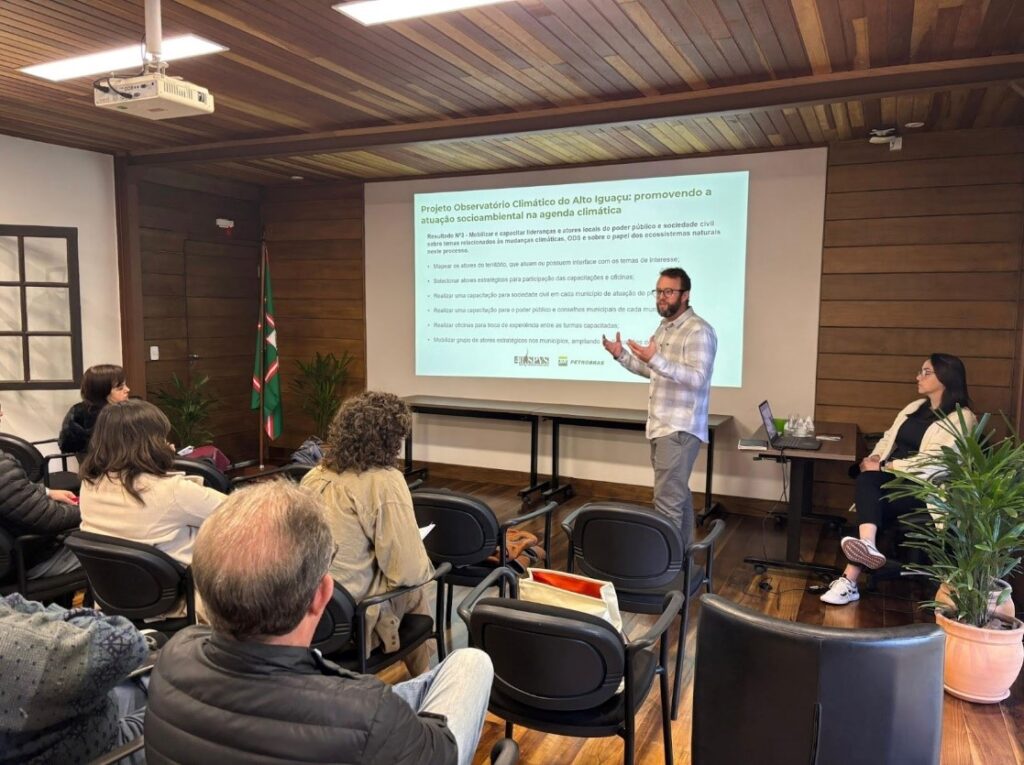
A meeting with the Municipal Secretariats of the Environment gathered officials to discuss an initiative focused on climate action in vulnerable areas of Curitiba and Araucária.
With an investment of R$ 4.2 million and a focus on vulnerable neighborhoods in Curitiba and Araucária, the Alto Iguaçu Climate Observatory (OCAI) project was officially presented in July to the Secretary of the Environment of the municipality of Araucária, at a meeting held at the Municipal Secretariat of the Environment of Curitiba (SMMA). The initiative, led by the Society for Wildlife Research and Environmental Education (SPVS), is part of the Petrobras Socio-environmental Program and proposes adaptation and mitigation strategies for climate change in Curitiba and the Metropolitan Region, with strong community participation.
In total, about 40 technicians from the Environmental Secretariats of the municipalities participated in the meetings. In the municipality of Curitiba, the event was attended and opened by Ibson Gabriel Martins de Campos from the Environmental Control Superintendency, representing Secretary Marilza do Carmo Oliveira Dias. In the municipality of Araucária, the meeting was attended by Secretary Tiago Rodrigo Mello. Both highlighted the relevance and importance of the partnership between SMMA and SPVS in implementing projects with a socio-environmental focus.
“This moment represents a great opportunity for us to discuss together such necessary and urgent issues regarding biodiversity conservation. We are pleased that SPVS has been chosen to lead the actions in partnership with us,” said Ibson.
The project coordinator at SPVS, Rafael Meirelles Sezerban, presented the objectives and strategies of the initiative, which will operate in the neighborhoods of Tatuquara and Campo de Santana in Curitiba, and Thomaz Coelho, Tindiquera, and Costeira in Araucária. These regions, located in the Iguaçu River basin, concentrate indicators of social and environmental vulnerability and have been defined as priorities for the territorial scope of the work.
The project stands out for its integrated approach.
Part of the scope of the Biodiversity Condominium Program (ConBio) by SPVS, the Observatory was one of the 44 projects selected in the latest call for the Petrobras Socio-environmental Program, having received the highest score in the technical evaluation. The financial support will ensure the execution of activities for a period of three years.
The proposal integrates green infrastructure, local environmental data generation, citizen education, and alignment with the Sustainable Development Goals (SDGs). During the presentation, Rafael detailed the five expected outcomes of the project, which range from mapping with InVEST software and socio-environmental surveys to the formation of Young Climate Leaders and training for civil society and public sector representatives.
“The project goes beyond raising awareness: it proposes real paths, based on science and popular participation, to tackle the challenges of the climate crisis with effective and lasting solutions,” emphasized the coordinator.
The technical presentation also reinforced commitments made at the symbolic signing event of the project, held in May this year at the Presidente Getúlio Vargas Refinery (Repar) in Araucária. On the occasion, Petrobras’ Executive Manager of Social Responsibility, José Maria Rangel, stated: “With the return of social and environmental investments in a regionalized manner, we are democratizing access to resources and reaffirming our commitment to society.”
Meanwhile, Repar’s General Manager, Felipe Leonardo Gomes, emphasized the project’s focus on protecting water resources, areas with Araucaria Forest, and the floodplains of the Barigui and Iguaçu rivers — strategic ecosystems for the climate resilience of the Metropolitan Region.
Present at the event, SPVS’s Executive Director, Clóvis Borges, also summarized the essence of the project: “Conserving nature supports the viability of businesses and promotes quality of life.”
Active participation and follow-ups
After the presentation, the meetings were opened for questions and suggestions from the SMMA officials of the municipalities. Among the topics raised were the schedule for executing activities and the adaptation of the area of operation according to local sub-watersheds. The contributions will be considered in the next phase of project planning.
At the end of the meeting, the SMMA reaffirmed their willingness to support the project through specific technical meetings with different departments of the city hall, aiming to facilitate the implementation of the next stages.
A further step in the local climate agenda
The meetings at the Environmental Secretariats of the municipalities not only marked the public launch of the Alto Iguaçu Climate Observatory’s actions in Curitiba and Araucária but also reaffirmed the leadership of the capital of Paraná and the Metropolitan Region in addressing the urban climate crisis. “With a solid technical foundation, popular participation, and a focus on socio-environmental justice, the Alto Iguaçu Climate Observatory has the potential to become a national reference in nature-based climate solutions,” concluded Rafael.
About SPVS
Founded in 1984, the Society for Wildlife Research and Environmental Education (SPVS) is one of Brazil’s most relevant conservation organizations, focusing on the conservation of the Atlantic Forest. It operates with innovation, a solid technical foundation, and a restorative vision of development, valuing nature as a strategic asset for human well-being and proper territorial management.www.spvs.org.br
Written by Claudia Guadagnin, press officer for the Society for Wildlife Research and Environmental Education (SPVS).
claudia@spvs.org.br/41. 99803-4948.