

Photo: Gabriel Marchi ©
Red-tailed Parrot and Vinaceous-breasted Parrot Conservation Program
In 2023, the Forest Foundation issued a public call for the hiring of services for population and reproductive monitoring of two parrot species found in the Atlantic Forest biome, the red-tailed parrot (Amazona brasiliensis) and the vinaceous-breasted parrot (Amazona vinacea). The program began in July 2023 and is expected to conclude in June 2026.
About the Program
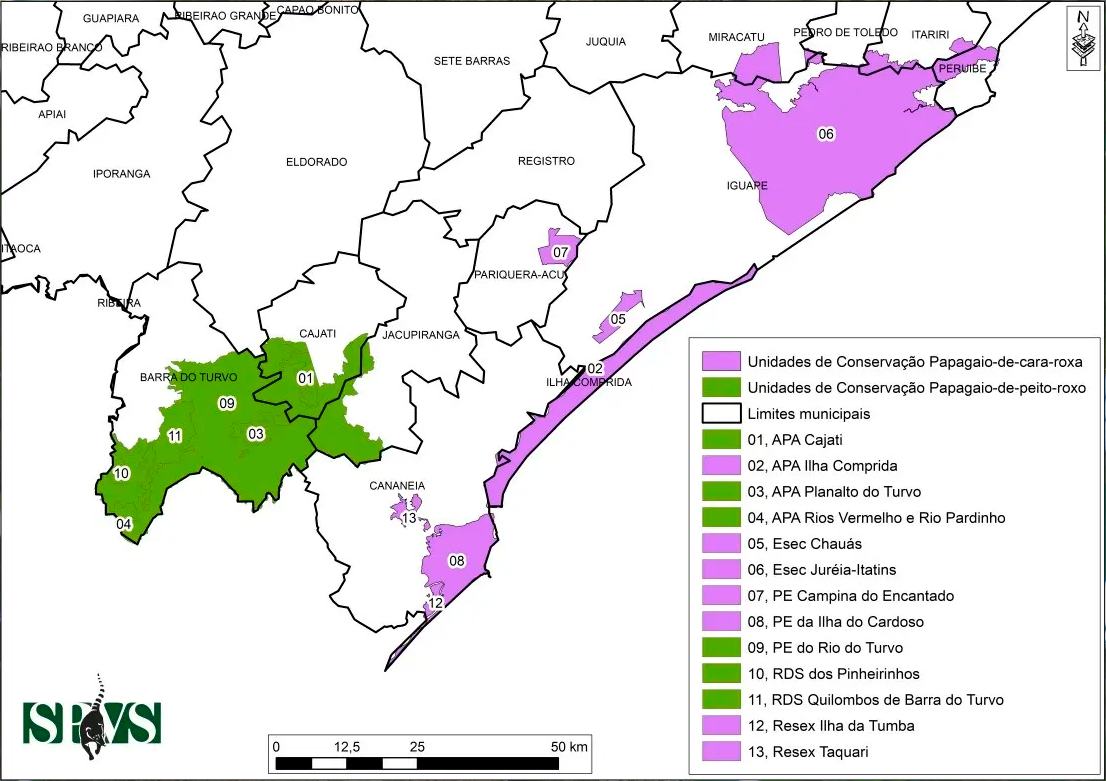
The main objective of the Red-tailed Parrot and Vinaceous-breasted Parrot Conservation Program is to understand the incidence and use of 13 Conservation Units (CUs) in the state of São Paulo by both parrot species, covering an area of approximately 253,000 hectares. In seven of them, the red-tailed parrot lives, and in six, the vinaceous-breasted parrot.
During the work, the program’s technical team will:
- Estimate the population size of each species;
- Locate the main roosting and breeding sites within the CUs and surrounding areas;
- Conduct reproductive monitoring and tracking; and
- Understand how the parrots use and interact with the natural environment where they live.
Communication actions, interaction with local communities, and environmental education initiatives are also planned to inform and raise awareness about the importance of the species and the CUs for the balance and conservation of the Atlantic Forest.
Red-tailed Parrot
The red-tailed parrot (Amazona brasiliensis) is an endemic species of the Atlantic Forest, meaning it exists only in this biome, and can be seen from the southern coast of São Paulo to the coast of Paraná. The species is impacted by habitat destruction and the illegal capture of chicks, having been on the National List of Threatened Species in the Vulnerable category for many years, according to the Ministry of the Environment (MMA), and is currently in the Near Threatened category. On the São Paulo state list of threatened species, it is in the Vulnerable category. In the state of SP, the population estimate is approximately 1,700 individuals.
Photo: Elenise Sipinski ©
Vinaceous-breasted Parrot
It is a species that primarily feeds on fruits but also consumes seeds, leaves, flowers, and their shoots. The pine nut, the seed of the araucaria, is one of the main items consumed by the vinaceous-breasted parrot in southern Brazil. The species occurs in the Southeast and South of Brazil, western Paraguay, and northeastern Argentina. They need tree holes (trunk hollows) and crevices formed by trunk decomposition to nest and reproduce. With the degradation of the Araucaria Forest, they have been losing food sources and places for reproduction and shelter.
Photo: Elenise Sipinski ©
Meet those who
support the project's actions
OF THE RED-TAILED AND PURPLE-BREASTED PARROT CONSERVATION